


Not all saunas work the same way, and if you've ever sat in a gym sauna wondering why it felt nothing like the one from your Finnish holiday, that's why. There are four main types: traditional wood-fired, electric, infrared, and steam rooms. The real difference between them isn't the shape or the price tag. It's how each one makes heat, because that single fact decides the temperature, the humidity, what it costs to run, and honestly, how the whole thing feels.
One more thing before we start, because it trips people up constantly. Heat source and format are two separate decisions. A barrel sauna, a cabin sauna, and a portable sauna tent aren't different heating technologies. They're just different boxes to put the heat in. The same wood stove that heats a permanent lakeside cabin can heat a tent pitched on your lawn.
We build and test wood-fired sauna tents here in the UK, which means we've spent a lot of January evenings sitting in 100°C heat while frost settles on the grass outside. So we have opinions. We'll try to keep them fair.
The Main Types of Sauna at a Glance
| Type | Heat Source | Temperature | Humidity | Heat-Up Time | Best For |
|---|---|---|---|---|---|
| Traditional wood-fired | Wood stove + stones | 70 to 100°C | 5 to 20% (spikes with löyly) | 30 to 45 min | Authenticity, ritual, outdoor use |
| Traditional electric | Electric heater + stones | 70 to 100°C | 5 to 20% | 15 to 30 min | Convenience, gyms, home installs |
| Infrared | Infrared panels | 45 to 65°C | Low, no löyly | 10 to 15 min | Gentler heat, longer sessions |
| Steam room | Steam generator | 40 to 50°C | Near 100% | 15 to 20 min | Respiratory comfort, moist heat |
| Portable sauna tent (wood-fired) | Wood stove + stones | 80 to 100°C | 5 to 20% | 20 to 30 min | Renters, small gardens, no planning permission |
1. Traditional Wood-Fired Sauna

A wood-fired sauna heats a stack of stones over a wood-burning stove until the air sits somewhere between 70 and 100°C. The air stays fairly dry, maybe 5 to 20% humidity, right up until you pour water over those stones. Then you get löyly: a wave of steam that rolls off the rocks and lands on your skin like a blanket someone just pulled out of the oven. Ask a Finn, and they'll tell you löyly isn't a feature of the sauna. It basically is the sauna.
Which is why, for a lot of people, this isn't one type among several. It's the reference point everything else gets compared to and usually falls short of.
Part of it is that the session starts long before you're sweating. You're out there stacking wood, lighting the stove, poking at it, waiting. Twenty minutes of nothing much. And somewhere in that waiting, your shoulders drop, and your phone stops mattering, and by the time the stones are ready you're already halfway to relaxed. No electric heater gives you that runway.
People assume traditional saunas are an endurance test. They're really not, or at least they don't have to be. Leave the stones alone, and the air is hot but dry and perfectly manageable. Throw a ladle of water on, and you've got thirty seconds of proper intensity, then it fades. You're the one holding the ladle, so you're the one deciding how hard the session goes.
That control is probably why the Finnish tradition has barely changed in centuries. Its oldest form, the chimney-free smoke sauna they call savusauna, still exists in rural Finland, though these days it's a pilgrimage rather than the norm.
Why Sauna Purists Still Choose Wood-Fired
Ask ten longtime sauna users why they burn wood when electricity exists, and you'll hear the same handful of things. The heat feels softer somehow. There's the smell of the wood, the low crackle from the stove, the fact that nothing about it can be rushed. None of that appears on a spec sheet. All of it is the reason they'd never switch.
It matters most outdoors. A wood-fired sauna in a garden or by a cold lake feels like it belongs there in a way a plugged-in cabin never quite does. If you're still deciding where yours should go, our outdoor sauna vs indoor sauna guide walks through that whole decision.
There's a boring practical upside too: once you've got a source of cheap seasoned firewood, each session costs pennies. A big electric heater running for two hours on UK electricity prices does not cost pennies.
Traditional Heat No Longer Means Permanent Construction
Here's the assumption we run into most often: wood-fired means a fixed timber building, a concrete base, a builder, and a spare fifteen grand.
It doesn't anymore. The stove-and-stones principle works exactly the same inside a well-insulated portable tent as it does inside a cabin. Same fire, same rocks, same löyly. We'll get into that properly in the formats section, because it deserves more than a paragraph.
2. Electric Sauna

AdobeStock/Kirill
An electric sauna swaps the wood stove for an electric heater, but the heater still warms real sauna stones, and the stones still heat the air to that same 70 to 100°C range. Pour water on them, and you still get löyly. Mechanically, it's closer to a wood-fired sauna than most people expect.
Where wood-fired is about ritual, electric is about removing friction. Press a button, come back in twenty minutes, get in. That's the entire process, and it's exactly why nearly every gym, hotel, and spa sauna in the UK runs on electricity.
The Biggest Advantage Is Control
An electric heater holds whatever temperature you set it to, indefinitely, without you touching anything. Most decent systems now come with digital controls and timers, so you can have the sauna hot before you've finished your commute home.
Anyone using their sauna four or five times a week starts to appreciate that very quickly. There's no fire management, no wood delivery, no ash to clear out on a Sunday.
And to bust a persistent myth: a good electric sauna does not feel meaningfully different from a wood-fired one once you're inside. Stones are stones. The temperatures sit in the same band, close to what we cover in what temperature should a sauna be, and the löyly works the same way.
What's missing is everything around the heat. No flame, no woodsmoke, no crackle. Whether that bothers you says more about what you want from a sauna than about the sauna itself. Plenty of people genuinely prefer the quiet.
Installation Considerations
The catch is the wiring. Anything beyond a small heater generally needs its own dedicated circuit, installed by a qualified electrician, and that bill lands before you've had a single session. Factor it in.
Running costs are the other thing to watch. Electricity in the UK has stayed expensive, and a 6kW or 9kW heater running regularly adds up in a way a wood pile doesn't. For occasional use it's fine. For daily use, do the maths first.
Still, if convenience is the priority, electric is hard to argue with. It's the sauna that asks the least of you.
3. Infrared Sauna

AdobeStock/Lukassek
An infrared sauna doesn't really heat the room at all. Panels emit far infrared, which warms your body directly, so the cabin itself only sits around 45 to 65°C. If a traditional sauna has ever made you feel like you were being cooked, this is the type people usually point you toward.
Infrared has grown faster than any other corner of the sauna market over the past decade, and the marketing has grown even faster. You'll see it sold as the smarter, more advanced sauna. Take that with a pinch of salt. It's a different experience, not an upgraded one.
The appeal is real, though. Because the air stays relatively cool, sessions don't feel like cardio. You warm up gradually from the inside, you can sit for forty minutes with a book, and you walk out sweating without ever having gasped at the ceiling.
Lower Temperatures, Different Experience
Anyone raised on Finnish saunas finds their first infrared session slightly strange. The air is warm rather than hot. Nothing sizzles. No steam ever rolls through the room, because there are no stones and nowhere to pour water. That means no löyly at all, and for traditionalists that's not a small omission. That's the whole point gone missing.
The honest way to put it: infrared sessions are calm, dry, and very consistent. Some people find that exactly right. Others find it a bit like decaf.
Energy Use and Practicality
Infrared panels draw noticeably less power than a big electric stone heater, for the obvious reason that warming one body takes less energy than warming an entire room to 90°C. They also reach temperature in ten or fifteen minutes, which is handy when the evening is short.
But don't buy a sauna on the electricity bill alone. The only sauna that ever pays for itself is the one you keep using, and that comes down to which experience you actually look forward to.
On the science: traditional sauna bathing has decades of research behind it, some of it large and long-term. Infrared research is younger and thinner. Not absent, just less. Worth knowing when you read the more breathless health claims online.
4. Steam Room (Wet Sauna)

AdobeStock/MinervaStudio
A steam room runs a steam generator to hold the space at around 40 to 50°C and close to 100% humidity. Strictly speaking, it isn't a sauna at all, but everyone compares the two, so leaving it out of a sauna guide would be a cop-out.
The experience is immediate. Steam fills the room within moments, and the air turns thick, warm, and wet, about as far from the dry snap of a Finnish sauna as heat gets. People say "wet sauna" casually, but the two use completely different machinery and feel nothing alike inside.
A Tradition Rooted in the Hammam
Steam bathing isn't a spin-off of the Finnish tradition. It grew up separately, most famously as the hammam, the Turkish bath, which has anchored communal bathing culture for centuries: warm steam, scrubbing rituals, tiled rooms built to be beautiful.
A modern leisure-centre steam room is a pale descendant of that, but the core idea survived intact. Moist heat, taken slowly, in company.
Why Do Some People Prefer Steam
Humidity changes what heat feels like. At near 100% humidity, your sweat can't evaporate, so your body can't cool itself, which is why a 45°C steam room can feel as fierce as a sauna running forty degrees hotter.
Plenty of people love exactly that: the wet warmth after a workout, or in the depths of February. Some find the moist air easier on the airways than bone-dry sauna heat, though that one genuinely varies person to person.
Maintenance Is the Trade-Off
Here's what the spa brochures skip. A room that is permanently wet and warm is a room that mould would like to live in. Steam rooms need serious ventilation design, proper drainage, and regular cleaning, or they turn grim fast.
It's the main reason you find them in commercial spas and very expensive houses rather than ordinary UK gardens. Building one at home is a construction project. Putting a sauna in the garden, by comparison, can be an afternoon.
What Is the Difference Between a Dry and Wet Sauna?
Dry and wet aren't two boxes. They're two ends of one humidity dial. A traditional sauna idles at the dry end and jumps toward wet every time water hits the stones, then drifts back. A steam room is parked permanently at the wet end and never moves.
So the real question behind "dry or wet?" is whether you want your hand on that dial. A traditional sauna hands you the ladle. A steam room has already decided for you.
Sauna Formats: Cabin, Barrel, and Portable
Quick recap, because this is the distinction the whole article hangs on: heat source is how a sauna works, format is where it lives. Sort the first question, then this one gets much easier.
Cabin and Indoor Saunas
A built-in cabin is the top of the price range, and it earns that position honestly. You're paying for construction, insulation, ventilation, and usually a room given over to it permanently. Converting space inside a UK home also brings building regulations and ventilation requirements into play, especially for anything wired to the mains. Beautiful when done well. Not a small undertaking.
Barrel Saunas
The barrel is the one everyone recognises, and the round shape isn't just for the photos. Warm air moves around a curved ceiling instead of pooling in corners, so barrels heat efficiently for their size.
The commitment is the thing to understand: a barrel wants a permanent spot in the garden, almost always a proper base underneath it, and depending on size and placement, UK planning permission can enter the conversation. Once that base is poured, you're not changing your mind cheaply.
Portable Sauna Tents

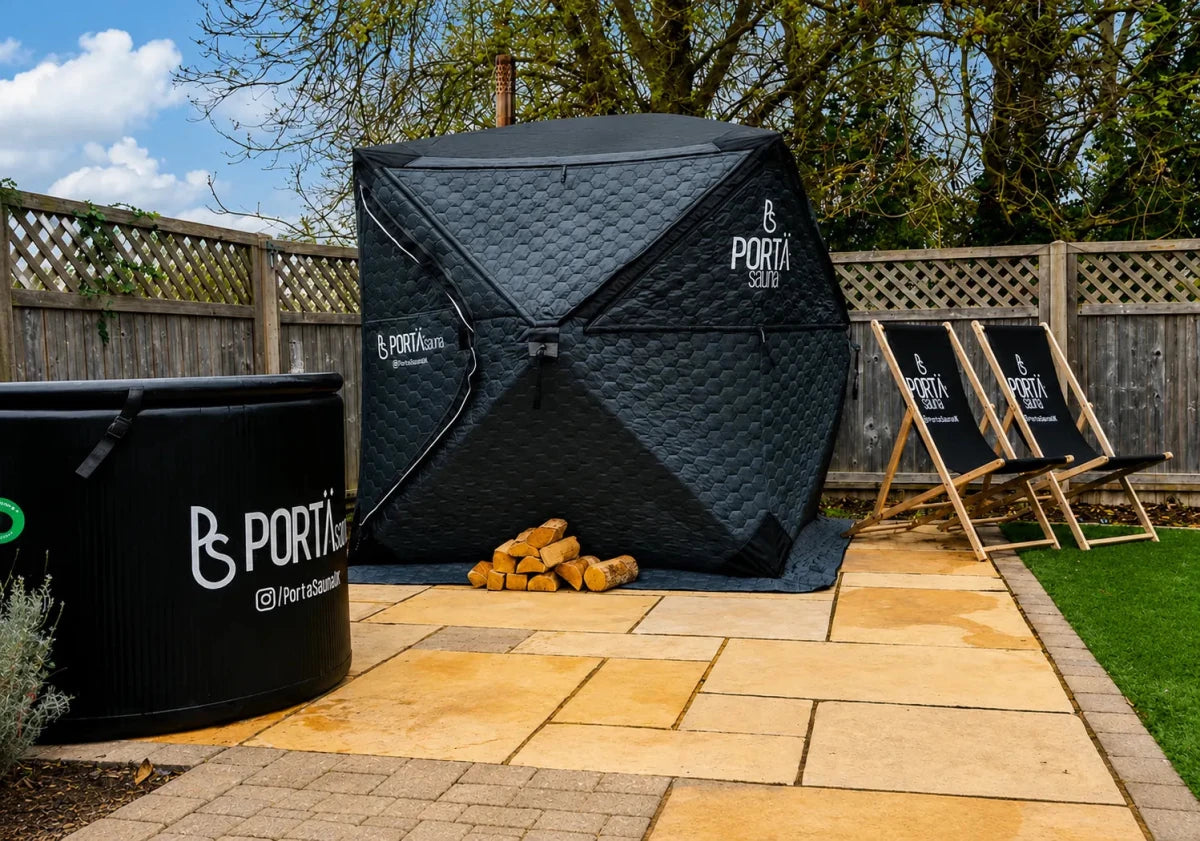
PortaSauna HEX in a UK garden
This is the format the big American sauna guides either skip or wave away in a sentence, and it's the one that's changed most in the last few years.
The scepticism was earned, to be fair. Early portable saunas were flimsy single-layer things with weedy electric heaters. They leaked heat, never got properly hot, couldn't make löyly, and convinced a generation of buyers that portable meant toy. Fair enough. That's what those were.
A modern insulated sauna tent is a different animal. The good ones run a real wood-burning stove with real stones, hit 80 to 100°C, and make löyly exactly the way a cabin sauna does, because it's exactly the same mechanism. Our PortaSauna HEX seats four to six, uses triple-layer insulated fabric, and holds sauna temperature with minus 12°C outside. We know because we've tested it in weather we wouldn't wish on anyone.
Setup takes about ten minutes. After that, the stove does what wood stoves have done for centuries, and when you're finished, the whole thing packs down for the shed or the car boot. Gardens, campsites, wild swimming spots. No base, no builder, no planning permission. It's also a fraction of the price of any permanent build, and our portable sauna cost breakdown puts actual numbers on that.
Browse the current range of sauna tents if you want to see what the format looks like now.
Which Type of Sauna Is Best for You?
There's no best sauna. There's the one that matches your situation, and most situations point somewhere fairly obvious once you lay them out.
- Want the real wood-fired experience but can't or won't commit to a permanent build? That's the exact gap insulated sauna tents were designed to fill. Real stove, real stones, real löyly, up to 100°C, and nothing to apply for or pour.
- Working with a small UK garden? Same answer for a different reason. A tent only occupies the lawn while you're actually using it.
- Find high heat genuinely unpleasant rather than pleasantly challenging? Infrared, at 45 to 65°C, is the type built for you, and there's no shame in it.
- Watching running costs? Wood wins if firewood is cheap where you are. Among the plug-in options, infrared draws the least.
- Renting, or likely to move? A tent comes with you. A barrel sauna becomes a gift to the next tenant.
None of these is the wrong answer. They're answers to different questions.
Pairing Any Sauna with Cold Water
Whatever you end up with, know that saunas have a natural partner. Heat then cold, cold then heat: contrast therapy is what the wild swimming crowd and half the athletes we know are doing every weekend, and it works with any of the four types.
Sit in the heat until your vessels open right up, then get into a cold plunge and feel everything slam shut again. The body sorts out the rest. Regulars will tell you the contrast is where the real reset lives, which is why so many garden setups now run both side by side.
Choosing Your Sauna
If this guide leaves you with one method, make it this: two decisions, in order.
First the heat source. Wood-fired, electric, infrared, or steam, chosen on the experience you'll actually crave on a wet Tuesday in November, not the one that looks best on Instagram. Then the format, chosen on what your space, budget, and tenancy agreement will genuinely allow.
Get those right, in that order, and the rest sorts itself. The best sauna was never the biggest or the most expensive one. It's the one you're still lighting on cold evenings three winters from now. If you suspect that's a wood fire in your own garden, have a look at what a modern sauna tent can do. The authentic version has got a lot easier to own.


Leave a comment
All comments are moderated before being published.
This site is protected by hCaptcha and the hCaptcha Privacy Policy and Terms of Service apply.